

Examiners in CIE 0400 / Edexcel 4AD1 reward candidates who treat 3D and mixed-media as a genuine investigation, not a decorative add-on. A small clay maquette tucked into a sketchbook spread can move a final mark from a high B to an A — but only when it visibly informs the final piece.
Where clay fits in AO1 (Develop ideas)
Use JOVI Plastilina (never dries) for rapid form-finding. Sculpt three thumbnail variations of the same idea in 10 minutes each, photograph, mount the photos opposite annotated sketches. The reusability is the point — examiners read iteration.
Where clay fits in AO2 (Experiment with media)
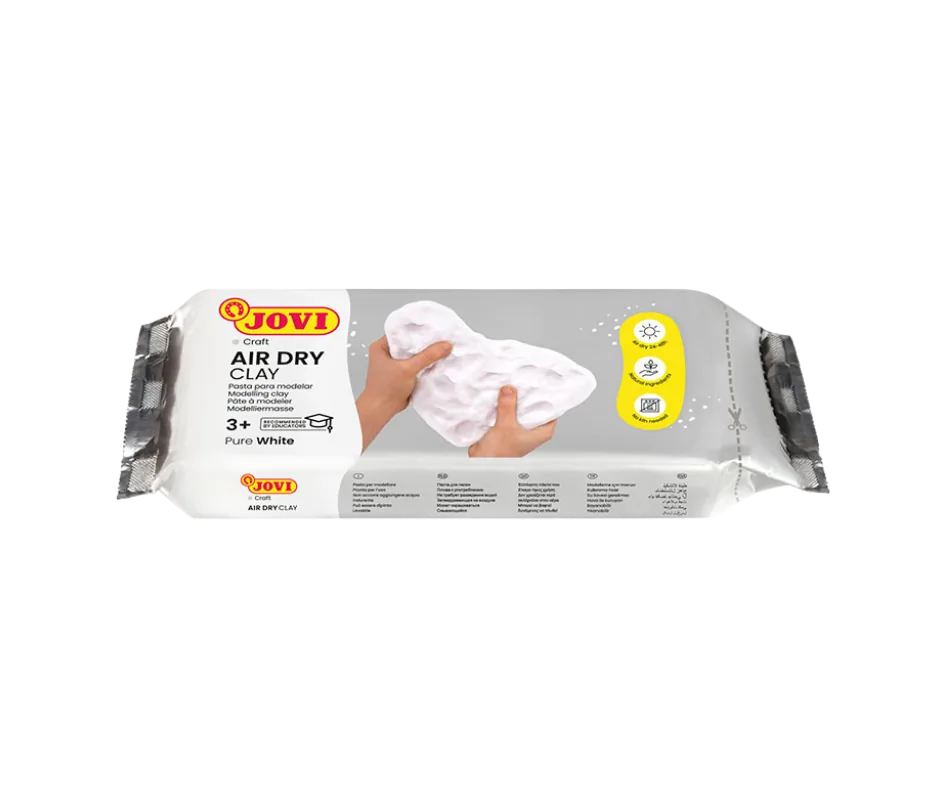
Switch to JOVI Air-Dry Clay (250 g) once the idea is committed. Document texture experiments: scored, sanded, painted with acrylic, washed with ink. Mount a small fired-look maquette inside the book with a paper hinge.
Where clay fits in AO3 (Record observations)
Sculpt a study of an observational object — a fruit, hand, drapery — in 1 kg clay. Photograph from four angles in raking light. Examiners specifically reward 3D observational studies, which are rare in candidate work.
Where clay fits in AO4 (Final piece)
For a 3D final piece, plan in plastilina, build in air-dry clay. Plastilina takes the structural pressure of repeated trial; the air-dry version becomes the permanent submission. A small finished sculpture from a 1 kg pack is the going rate at IB/IGCSE moderation.
Recommended JOVI pack list for IGCSE candidates
Plastilina Classic 10 (RM29.90) · Air-Dry Clay 250 g (RM16.90) for sketchbook studies · Air-Dry Clay 1 kg (RM48.90) for the final piece · 5-piece Modelling Spatulas (RM12.50). Total under RM110 for a full coursework cycle.
Why air dry clay suits IGCSE coursework in Malaysia
Cambridge and Edexcel both reward evidence of genuine media experimentation, but most Malaysian candidates work at home or in a general art room with no kiln and no technician. Air dry clay removes that constraint entirely. A candidate can make, photograph, destroy and remake a maquette across a weekend, and the whole cycle is documentable in the sketchbook — which is what AO2 is actually assessing. Fired ceramics, by contrast, give you one attempt per firing window and a piece that cannot be cut open or reworked once it is out of the kiln.
The practical trade-off is drying time. In a Malaysian home without air conditioning, a maquette thicker than about 15 mm can take 72 hours or more to dry through, and rushing it in direct sun is the most common cause of cracking. Candidates working to a deadline should build hollow or over an armature, and should plan drying into the schedule rather than treating it as an afterthought. Our drying-time guide gives real timings by project weight for both air-conditioned and non-air-conditioned rooms.
Documenting the process for the examiner
Marks are lost far more often on documentation than on making. Photograph each stage against a plain background in daylight, including the failures — a cracked first attempt with a written note on what you changed is stronger AO2 evidence than three clean photographs of a finished object. Annotate with the specific decision you made and why, not a description of what the photograph already shows. Where a clay study informed a final piece in another medium, show that link explicitly; examiners will not infer it.
For the final piece itself, remember that air dry clay is not weatherproof and is more fragile than fired ceramic. Seal finished work with an acrylic varnish before it is handled or transported, and build a simple support if the piece has thin projecting elements. Schools submitting coursework by post should photograph the piece before packing it.
What teachers should stock for an IGCSE cohort
For a cohort of twenty candidates working through a term of three-dimensional development, budget roughly 500 g of air dry clay per candidate for maquette work, plus additional 1 kg packs for those taking a sculptural final piece. Pure White takes paint and surface treatment most predictably; Terracotta and Stone Grey are useful where a candidate wants the raw material colour to read as part of the work. Two or three shared sets of 5-piece modelling spatulas per class are sufficient. Departments ordering at this scale should use school bulk pricing rather than retail, and the free teacher resource library includes a pre-filled risk assessment and editable rubrics that map to the assessment objectives above.